Home · Walks & essays · England-wide
Essay
Walking in fog: what it is, when it forms and how to keep your bearings
A clear, still night in late autumn often leaves the valleys full of fog by morning. It can make a familiar walk feel like a new one, and it can also make a simple field path surprisingly hard to follow.
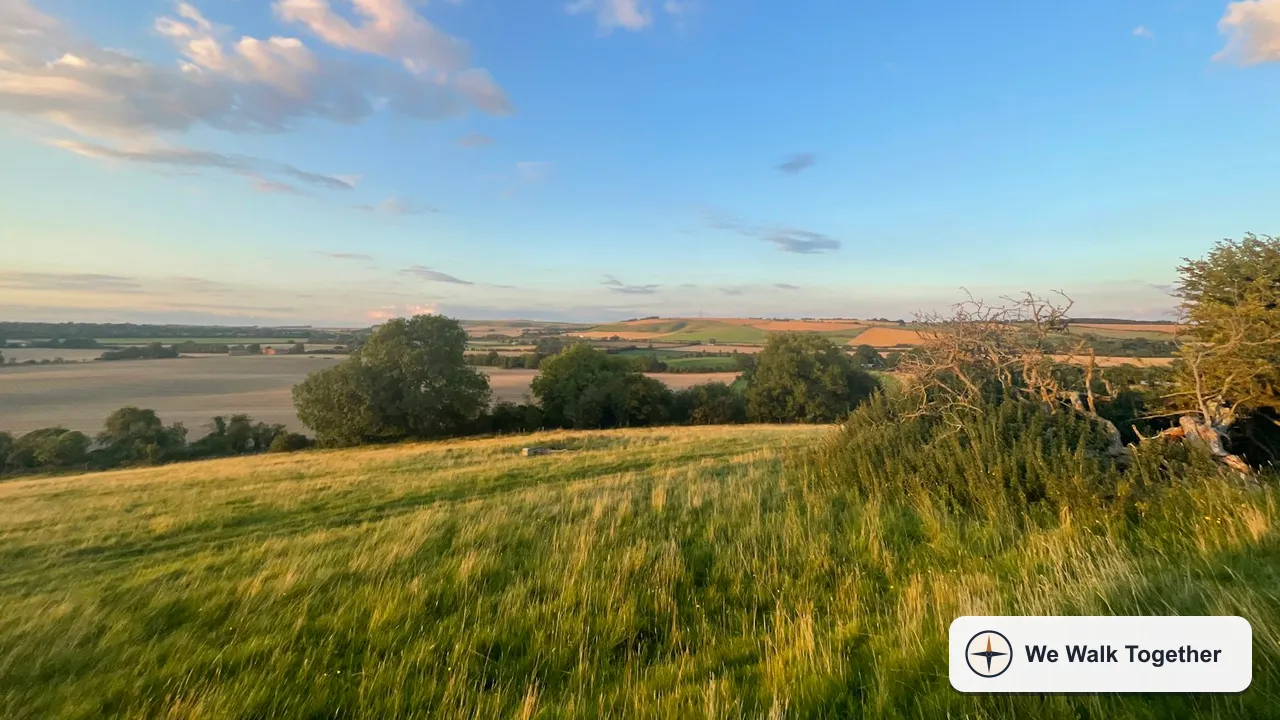
Fog is cloud at ground level that cuts visibility to less than 1,000 metres, and in the UK it is most common on calm, clear nights in late autumn and winter, gathering in valleys and near rivers. On a lowland walk it rarely lasts all day. But while it is down, the usual landmarks vanish, and walkers who know a route by sight can go wrong in a field they have crossed a hundred times. A map, a compass and a habit of following linear features solve most of the problem.
What the Met Office means by fog
The Met Office's guide to fog gives a few useful thresholds:
- Fog: visibility below 1,000 metres.
- Dense fog: visibility below 100 metres.
- Fog in public forecasts: generally means visibility below 180 metres, the point where it starts to matter for most people.
- Mist: visibility above 1,000 metres.
On a field path, 100 metres is roughly the distance across a small paddock. Below that, the next stile or gate will often be out of sight from the last one.
Why it gathers where you walk
Fog needs moisture, light winds and air cooled to the point where water condenses. The type most walkers meet in autumn is radiation fog. On a clear, calm night the ground loses heat to the sky and chills the air just above it. If that air is moist enough, fog forms. Cold air drains downhill, which is why valleys and river meadows fill first, and the Met Office notes that moist air near lakes and rivers reaches its fog point at a higher temperature than drier air elsewhere.
The good news is that radiation fog usually clears soon after sunrise as the sun warms the ground, though on short, weak-sunned December days it can linger well into the afternoon. Often the simplest answer is to climb out of it. A path up onto a ridge or a down can take you from grey murk into bright sunshine, with the valley below looking like a white lake.
There are other kinds. Advection fog forms when moist air moves over a colder surface, such as the sea, and the east coast is known for a sea fog locally called haar. Freezing fog forms in cold, clear, calm winter conditions, and the supercooled droplets freeze on contact with surfaces, leaving the feathery white ice called rime. The Met Office says rime is rare at low levels in the UK but more common on mountain tops.
Keeping your bearings on a field path
Most lowland navigation in fog comes down to not losing the thread between one feature and the next. A few techniques do most of the work:
- Use handrails. Hedges, walls, streams and field edges are long features you can follow without seeing far ahead. Plan the route so that as much as possible runs alongside one.
- Take a bearing across open ground. If the path crosses the middle of a field, set your compass from the map before you leave the stile, then walk on that bearing to the other side. Our guide to reading an Ordnance Survey map covers the basics.
- Aim off. If you are heading for a gate on a long hedge, deliberately aim a little to one side. When you reach the hedge, you will know which way to turn.
- Count paces or time. Knowing that the next gate is about 300 metres away, and roughly how long that takes you, stops you walking straight past it.
- Tick off features. Note each junction, bridge or building as you pass. If one does not appear when expected, stop and work out where you are before going further.
Phones in fog
A phone's GPS works perfectly well in fog and is a good check on your position. Keep it warm and charged, carry a paper map as a backup, and do not let it replace looking at the ground. Batteries drain faster in cold, damp weather.
If you do lose the path
Stop as soon as you are unsure, rather than pressing on in the hope that something familiar appears. Look back the way you came: the last gate or stile may still be visible, and returning to it gives you a fixed point to start again from. Check the map for the nearest long feature, such as a hedge, a stream or a lane, and walk to it on a bearing. Once you are on a handrail, follow it to a junction you can identify. In a group, keep together and agree before anyone sets off to look; splitting up in fog is how one lost walker becomes three.
On the roads
Fog is most dangerous where walkers and cars meet. The Highway Code's rules for pedestrians ask walkers to wear or carry something light-coloured, bright or fluorescent in poor daylight, and to keep to the right-hand side of a road without a pavement so they face oncoming traffic. In fog, drivers see you later than they would on a clear day, even with lights on. If a lane section can be avoided by using a field path, it usually should be.
Fog and the walking landscape
There is real beauty in a foggy walk. Sounds carry strangely: a tractor across the valley seems close, a pheasant explodes from the hedge right beside you. Spider webs on gates are picked out in water droplets, and old trees loom out of the white one at a time. Historic landscapes feel especially strange. A walk around the stones at Avebury on a foggy morning, with each stone appearing only as you reach it, is one of the more memorable winter experiences in southern England.
Fog also teaches good habits. The walker who reads the map at every junction in fog is the one who rarely goes wrong on a clear day. Treat the grey mornings as practice, keep a hedge on one side, and enjoy the moment the sun burns through.